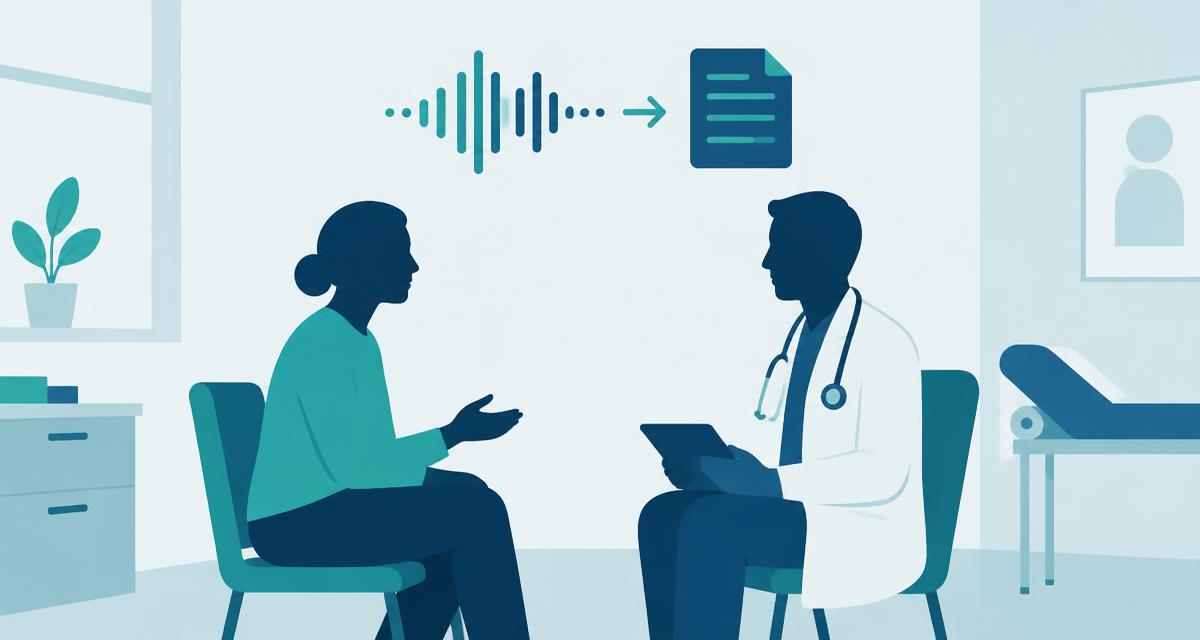
Welsh Medical Interpreter Service: Ensuring Clinical Safety and Compliance
What if the minutes spent waiting for a human linguist to arrive at a bedside are the difference between a safe diagnosis and a critical clinical error? For healthcare providers in Wales, the "Active Offer" isn't just a policy requirement; it's a fundamental pillar of patient safety. Integrating a professional welsh medical interpreter service into your workflow ensures that language choice never compromises the speed or quality of care. It's about moving beyond the administrative burden of traditional booking systems to provide immediate, compliant support when it matters most.
You likely recognise that meeting the Welsh Language (Wales) Measure 2011 standards whilst managing intense operational pressures is a constant balancing act. This article explores how Doctoria Real-time Interpretation provides a robust infrastructure for clinical accuracy and legal compliance. We'll examine the shift towards AI-enabled solutions that reduce risk and eliminate the logistical delays often associated with manual translation services. By prioritising data privacy and clinical precision, you can ensure that every patient interaction is both inclusive and safe.
Key Takeaways
- Understand the clinical implications of the Welsh Language (Wales) Measure 2011 and the legal necessity of the "Active Offer" in healthcare.
- Identify the operational advantages of integrating a digital welsh medical interpreter service to eliminate the delays associated with traditional human interpreter booking.
- Learn how real-time interpretation technology facilitates immediate communication in high-stakes emergency environments where every second is vital.
- Explore the technical framework that ensures Doctoria Real-time Interpretation maintains total data privacy and adheres to NHS DTAC and GDPR standards.
- Discover how to reduce administrative overhead whilst improving the inclusivity and reliability of clinical consultations for Welsh-speaking patients.
The Necessity of Welsh Medical Interpreter Services in Modern Healthcare
Effective clinical communication is the foundation of patient safety. A welsh medical interpreter service provides the essential bridge between English and Welsh in healthcare environments, ensuring that language choice doesn't become a barrier to care. Traditionally, this meant booking human linguists days in advance, often resulting in significant operational friction. The shift towards on-demand digital solutions now allows for immediate support, reducing the operational risks associated with delays in emergency or acute settings where every second matters.
Legal Duties and Patient Rights in Wales
The legal framework in Wales is explicit. The Welsh Language Act 1993 and the Welsh Language (Wales) Measure 2011 establish Welsh as an official language that must be treated with equal validity to English. Utilising an English to Welsh language translator isn't merely a courtesy; it's a matter of patient dignity and statutory compliance. Historical structures like the Wales Interpretation and Translation Service (WITS) have long supported these efforts across the public sector. However, modern clinical pressures require faster, more integrated technological answers to meet these standards without increasing the administrative burden on frontline staff.
The Impact of Language Barriers on Clinical Outcomes
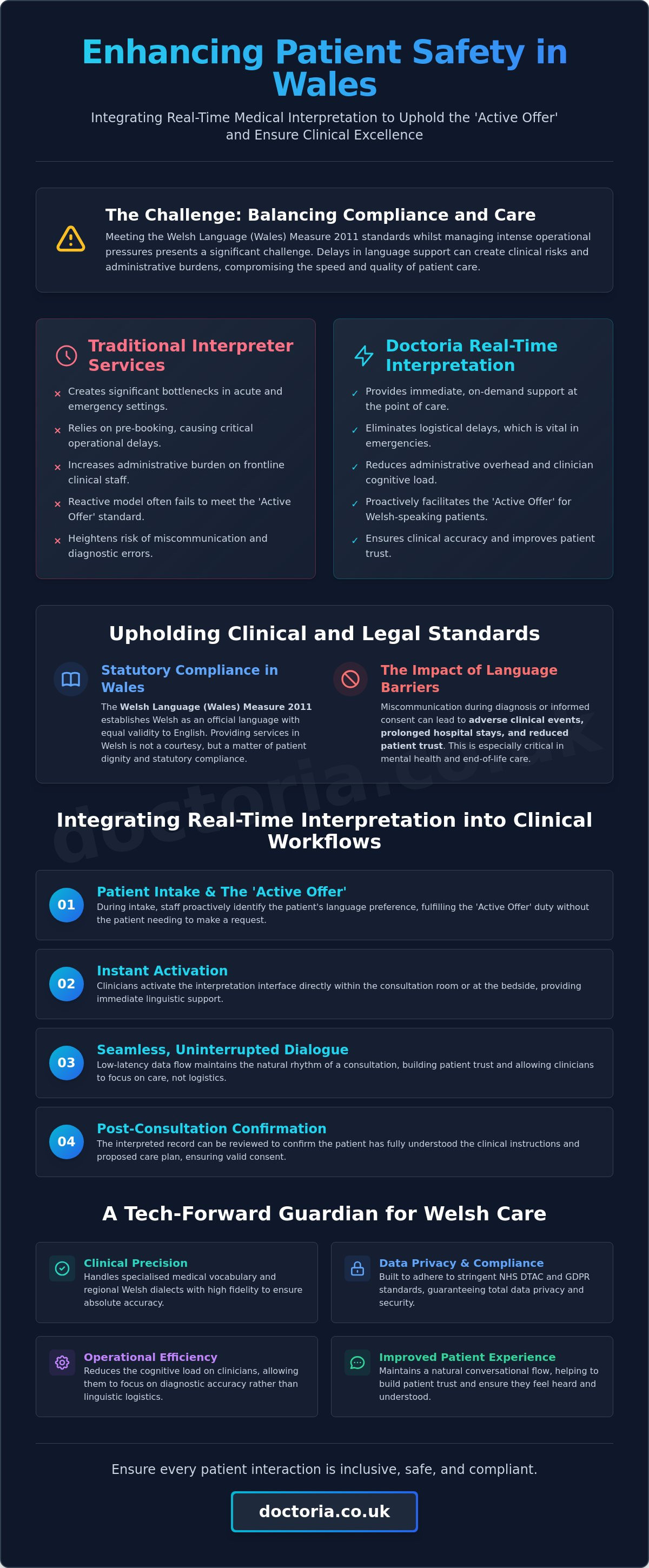
Language barriers create tangible clinical risks. Miscommunication during a diagnosis or when seeking informed consent can lead to adverse events and prolonged hospital stays. This is particularly sensitive in mental health and end-of-life care, where the nuances of expression are critical to the quality of care and the patient's emotional well-being. Clear communication ensures that patients fully understand their health issues and the proposed interventions, which is a prerequisite for valid consent. The 'active offer' is the proactive clinical responsibility to provide services in Welsh at the point of contact without the patient having to request them. Relying on a reactive welsh medical interpreter service model often fails this standard, leading to diagnostic delays and reduced patient trust in the healthcare system.
Integrating Real-Time Interpretation into Clinical Workflows
Traditional methods for securing a welsh medical interpreter service often rely on pre-booked human linguists. This model is functional for elective procedures but creates significant bottlenecks in acute or emergency settings. When a patient arrives in A&E, clinicians don't have the luxury of waiting for an off-site interpreter to travel or connect via a manual switchboard. Real-time technology removes these operational delays by providing immediate linguistic support at the point of care.
Steps for Implementing AI Interpretation in Practice
Integrating digital interpretation into a busy clinical environment requires a streamlined approach. The process begins during patient intake, where staff identify the need for Welsh language support as part of the "Active Offer." Clinicians then activate the interpretation interface directly within the consultation room, allowing for an uninterrupted dialogue. Following the consultation, the interpreted record is reviewed to confirm that the patient has fully understood the clinical instructions and the proposed care plan.
Ensuring Clinical Accuracy and Performance
High-stakes environments demand absolute precision. Modern platforms are designed to handle specialised medical vocabulary and regional Welsh dialects with high fidelity. By utilising low-latency data flow, these systems maintain the natural rhythm of a consultation, which is vital for building patient trust. This technological support reduces the cognitive load on clinicians, allowing them to focus entirely on diagnostic accuracy rather than linguistic logistics. For organisations looking to enhance their communication infrastructure, Doctoria Real-time Interpretation for Healthcare provides a robust welsh medical interpreter service that maintains clinical safety whilst meeting language obligations.
Doctoria® Real-Time Interpretation: A Tech-Forward Guardian for Welsh Care
Doctoria® Real-time Interpretation acts as a vital infrastructure partner for NHS organisations, moving the welsh medical interpreter service away from fragmented, manual booking and into a unified digital workflow. By automating the linguistic bridge, clinicians focus on the patient whilst the technology handles the complexities of real-time translation. This integration is particularly effective when used alongside automated medical documentation for doctors, ensuring that the interpreted dialogue is accurately captured in the clinical record without additional typing or administrative overhead.
Data Privacy and Institutional Trust
Patient confidentiality is non-negotiable in high-stakes clinical environments. Doctoria® adheres to strict UK healthcare data standards, including GDPR and the NHS Digital Technology Assessment Criteria (DTAC). Every consultation processed through our welsh medical interpreter service is protected by robust security protocols that prioritise total data privacy. We maintain detailed audit trails to ensure transparency and accountability in multilingual record-keeping. This rigorous approach to security provides administrators with the confidence that language accessibility doesn't come at the cost of data integrity.
Enhancing the Patient Experience in Wales
Inclusive care is a core objective of the "More than just words" framework. When patients can communicate in their first language, trust in the healthcare system increases and clinical outcomes improve. Doctoria® supports this mission by providing a reliable, tech-forward guardian for Welsh language rights. The future of healthcare in the UK is increasingly multilingual and AI-assisted. By adopting these tools today, providers can meet their legal duties whilst delivering empathetic, high-performance care to every Welsh-speaking patient. This shift reduces the cognitive load on the workforce and ensures that clinical safety remains the primary focus of every interaction.
Securing the Future of Welsh Language Care
Modern healthcare requires a shift from reactive language support to proactive, real-time accessibility. By prioritising the "Active Offer," providers can fulfil their legal duties under the Welsh Language (Wales) Measure 2011 whilst ensuring patient safety in high-stakes environments. A digital welsh medical interpreter service bridges the gap between statutory requirements and clinical reality, removing the delays of traditional booking systems. This approach reduces clinical risk and empowers patients to engage fully with their care in their first language.
Doctoria® provides a robust infrastructure designed specifically for mission-critical healthcare environments. Supported by Innovate UK funding and fully compliant with NHS data security standards, our platform ensures that every consultation is safe, secure, and accurate. Clinicians can focus on diagnosis and treatment rather than linguistic logistics. Discover how Doctoria Real-time Interpretation supports inclusive care and helps your organisation meet its linguistic obligations with confidence. Delivering equitable care across Wales is now more achievable than ever.
Frequently Asked Questions
Is real-time AI interpretation accurate enough for Welsh medical consultations?
Modern AI systems are engineered to process complex medical vocabulary and regional Welsh dialects with high fidelity. These platforms use advanced linguistic models trained on clinical datasets to ensure that nuances in patient expression are captured accurately. This reduces the risk of diagnostic errors that can occur when language barriers exist. By maintaining a low-latency data flow, the technology supports a natural, empathetic dialogue between the clinician and the patient.
How does a Welsh medical interpreter service comply with the Welsh Language Measure 2011?
A digital welsh medical interpreter service ensures compliance by facilitating the "Active Offer" at the point of care. The Welsh Language (Wales) Measure 2011 requires that the Welsh language is treated no less favourably than English in public service delivery. Real-time tools allow NHS organisations to provide immediate access to Welsh-speaking support without the delays inherent in manual booking systems. This proactive approach meets statutory obligations whilst improving patient safety.
Can AI interpretation be used in emergency healthcare settings in Wales?
AI interpretation is specifically designed for high-stakes environments where immediate communication is a clinical necessity. In A&E or ambulance services, waiting for a human interpreter to arrive can compromise patient safety. Doctoria Real-time Interpretation provides instant linguistic support, allowing clinicians to gather vital history and symptoms during the initial assessment. This speed of intervention is critical in mission-critical environments where rapid response times are paramount.
What are the data security implications of using AI for Welsh language services in the NHS?
Using AI for a welsh medical interpreter service requires strict adherence to UK healthcare data standards, specifically the NHS Digital Technology Assessment Criteria (DTAC) and GDPR. Doctoria prioritises total data privacy by ensuring that all patient interactions are encrypted and processed within secure frameworks. Professional medical interpretation platforms maintain detailed audit trails and do not store sensitive patient data for model training. This ensures that institutional trust and patient confidentiality are maintained throughout the consultation.