Medical Digital Dictation Solutions: The 2026 Procurement and Implementation Guide
Recent studies confirm that 77% of clinicians take patient notes home to complete charting. This contributes to an average of 1.84 hours of administrative work performed outside of contracted sessions every day. This operational overhead is no longer a mere inconvenience; it's a systemic risk to both staff well-being and patient safety. To mitigate these pressures, NHS organisations are increasingly prioritising the procurement of enterprise-grade medical digital dictation solutions that integrate high-fidelity hardware with secure AI logic.
You understand that legacy hardware and slow letter turnarounds are hindering clinical efficiency. This guide provides a definitive roadmap for selecting and implementing robust digital dictation services within the 2026 UK healthcare landscape. We will examine the shift toward ambient AI scribes, navigate the new August 2026 NHS procurement frameworks, and demonstrate how the Doctoria® and Philips partnership meets the critical June 30th DSPT requirements. By the end of this guide, you'll have a clear strategy to reduce documentation time by up to 40% whilst ensuring total data security.
Key Takeaways
- Understand the strategic shift from standalone recording devices to integrated clinical data management systems that reduce operational risk.
- Identify the core hardware and cloud-based infrastructure components, including Philips SpeechMike technology, essential for secure remote working.
- Navigate the updated NHS SBS Framework to ensure the compliant procurement of medical digital dictation solutions before the 2026 deadlines.
- Evaluate the total cost of ownership (TCO) and learn how to balance traditional dictation with ambient AI documentation for maximum ROI.
- Discover how the Doctoria® and Philips partnership streamlines the transition from speech to structured clinical notes whilst ensuring total data privacy.
The Evolution of Medical Digital Dictation Solutions in 2026
The clinical environment in 2026 requires more than just voice capture. It demands a systemic integration of audio data into the Electronic Health Record (EHR). Modern medical digital dictation solutions have transitioned from being peripheral tools to central infrastructure. This evolution addresses the acute administrative crisis within the NHS, where documentation bottlenecks often delay patient care and increase clinician burnout. By automating the flow of information, these systems reduce the time clinicians spend on manual data entry. It allows a focus on direct patient interaction instead of screen-based administration.
From Analogue to AI: A Brief History
Legacy tape-based systems are no longer just inefficient; they're a clinical risk. Physical media can be lost, corrupted, or lack the encryption required by 2026 data standards. The mid-2020s saw the emergence of 'Digital Dictation 2.0', a shift where interoperability became the primary metric for success. Systems no longer exist in isolation. They must now communicate directly with hospital administration software and regional data hubs. The rise of Automated medical scribes has further refined this process. We've moved beyond simple speech-to-text into intelligent data structuring that aligns with NHS clinical coding requirements. This ensures that every dictated word contributes to a searchable, structured clinical history.
Defining Modern Medical Dictation Services
Enterprise dictation is not a smartphone app. It's a sophisticated framework that relies on high-fidelity, clinical-grade hardware. Devices like the Philips SpeechMike series are essential because they filter out background hospital noise. This significantly reduces transcription error rates. Consumer-grade microphones often fail to capture the nuances of complex medical terminology. This leads to inaccuracies in patient records that require manual correction. These consumer devices also lack the UK GDPR and DTAC compliance markers essential for patient confidentiality.
Core Components of Enterprise Medical Dictation Services
Hardware vs. Software: Finding the Balance
Clinician adoption depends heavily on hardware ergonomics. Professional-grade devices like the Philips SpeechMike Premium and Pocket Memo are designed for long-term use. Their slide-switch operation and antimicrobial surfaces are essential for preventing repetitive strain and maintaining hygiene standards. These devices provide the high-fidelity audio necessary for modern speech recognition engines to function accurately. If the initial audio capture is poor, the subsequent data flow is fundamentally flawed.
The software layer has shifted toward cloud-hosted environments. This allows for centralised administration and instant updates across an entire Trust or private clinic. Secure file transfer protocols enable off-site transcription support, allowing secretaries to work remotely without compromising security. Within this framework, organisations must choose between front-end speech recognition, where the clinician sees text in real-time, and back-end processing, where the audio is converted after the recording is finished. Each approach has distinct implications for turnaround times and administrative overhead.
The Integration Layer: EPR and PAS
Seamless data flow into Electronic Patient Records (EPR) like EMIS or SystmOne is non-negotiable in 2026. Manual data entry is a primary source of clinical error; automating patient demographics eliminates this risk. Modern systems ensure that dictations are automatically attached to the correct patient record through a direct link with the Patient Administration System (PAS). This creates a closed-loop documentation process that is both efficient and auditable.
The NHS England guidance on AI scribing highlights the importance of choosing products that reduce the cognitive load on healthcare staff. This objective is at the heart of recent advancements in automated medical documentation for doctors. By removing the friction between speaking and charting, organisations can significantly improve clinical throughput. For those looking to modernise their existing infrastructure, Doctoria® solutions for digital dictation provide the necessary technical bridge between Philips hardware and advanced clinical data management.

Strategic Evaluation: Legacy Systems vs. AI-Enhanced Solutions
Procurement officers often mistake the initial hardware outlay for the total cost of ownership (TCO). A true strategic evaluation looks beyond the price of a microphone. It encompasses maintenance, cloud licensing, and the value of clinical hours reclaimed. In the current NHS climate, medical digital dictation solutions must be viewed as an investment in clinical capacity. When documentation time is reduced by 30-40%, as seen with AI-powered systems, the ROI is measured in increased patient throughput and reduced staff burnout. This systemic efficiency lowers the reliance on expensive, slow-turnaround outsourced transcription services.
The ROI of Modern Dictation Workflows
Calculating the return on investment requires a granular look at administrative bottlenecks. It's not just about how fast a doctor speaks; it's about how quickly that data becomes a structured clinical note. High-accuracy speech recognition engines significantly reduce the time secretaries spend on manual correction. This allows administrative staff to focus on higher-value tasks, such as patient coordination. Faster turnaround for discharge summaries and specialist letters directly improves patient safety by ensuring the next link in the care chain has the necessary information without delay.
- Clinical Reclaim: Reducing the 1.84 hours of daily administrative work performed outside of office hours.
- Transcription Costs: Lowering the TCO by moving from per-line outsourced billing to predictable enterprise licensing.
- Error Mitigation: Utilising high-fidelity audio to lower the 7.4% error rate often found in unrefined speech-recognition outputs.
Dictation vs. Scribing: Choosing the Right Tool for the Task
The choice between traditional dictation and ambient documentation depends on the clinical context. Traditional dictation remains the gold standard for high-complexity reporting. In radiology or pathology, where specific terminology and structured formats are paramount, the clinician needs direct control over every word. The Doctoria® Solutions for Digital Dictation, integrated with Philips hardware, provide this level of precision. These environments require a focused, declarative input that ambient tools cannot yet replicate with the same level of technical accuracy.
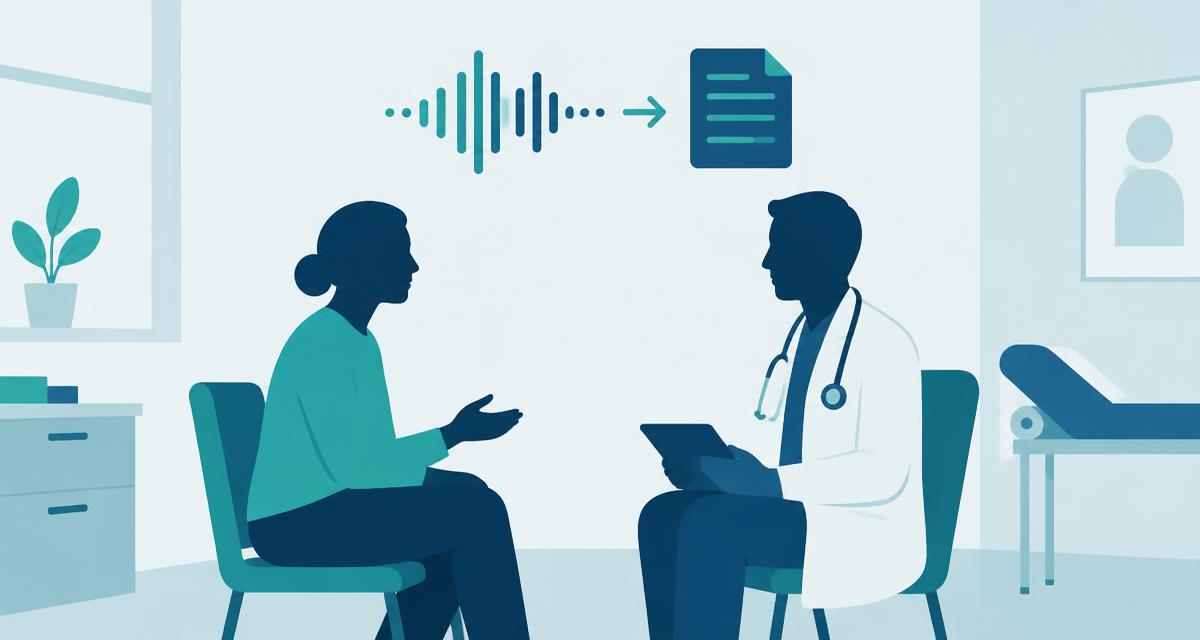
Conversely, the Doctoria AI Scribe for Healthcare takes the lead in patient-facing consultations. It captures the natural dialogue between clinician and patient, allowing the doctor to maintain eye contact and build rapport. This ambient documentation logic structures the conversation into a clinical note automatically. By integrating both workflows, Doctoria® provides a unified documentation experience that scales from a single GP practice to a multi-site Trust. This scalability is supported by a commitment to clinical safety, moving beyond basic GDPR to meet the rigorous DCB0129 and DCB0160 standards required for digital health technologies in the UK.
Navigating NHS Procurement for Digital Dictation
NHS procurement for medical digital dictation solutions is governed by strict frameworks designed to streamline the acquisition of clinical technology. The NHS Shared Business Services (SBS) framework, specifically SBS10505, remains the primary vehicle for Trusts seeking digital dictation and speech recognition. This framework, active until September 2027, allows organisations to bypass lengthy full-tender processes. Instead, procurement teams can conduct a mini-competition amongst pre-approved suppliers. This approach ensures that all vendors already meet foundational quality and security benchmarks, focusing the evaluation on specific local requirements and ROI.
During the proof-of-concept (PoC) phase, clinicians must test hardware integration and audio clarity in real-world ward conditions. It's vital to ask how the system handles intermittent connectivity and its compatibility with existing thin-client environments. Procurement must also align with the NHS 'Cloud First' strategy. This prioritises software-as-a-service (SaaS) models that offer superior scalability and disaster recovery compared to legacy on-premises servers. Selecting a cloud-native solution ensures the infrastructure can adapt to changing clinical volumes without requiring expensive local hardware upgrades.
Compliance Checklists for IT Managers
Data residency is a non-negotiable requirement. IT managers must verify that all patient data remains on UK-based servers to satisfy UK GDPR and the Data Security and Protection Toolkit (DSPT) version 8 requirements by the June 30, 2026, deadline. Evidence of Cyber Essentials Plus and ISO 27001 certifications provides the necessary assurance of a vendor's security posture. For AI-integrated systems, checking for validation from bodies like Innovate UK adds a layer of safety-critical verification, ensuring the logic used for documentation is robust and clinically safe.
Implementation Strategies for Large Trusts
As you evaluate framework providers and prepare your procurement strategy, consider how Doctoria® solutions for digital dictation align with these stringent NHS standards to provide a secure, future-proof documentation environment.
Doctoria & Philips: The Gold Standard for 2026
The partnership between Doctoria® and Philips represents a critical convergence of high-fidelity hardware and advanced clinical intelligence. Whilst many medical digital dictation solutions offer software in isolation, this collaboration ensures the entire data pipeline is secure and optimised. Philips provides world-class recording devices, such as the SpeechMike Premium, known for their precision and durability in high-pressure medical environments. Doctoria® layers this with a sophisticated AI engine that understands the complexities of the UK healthcare sector. This mission-driven approach prioritises the reduction of operational risk by ensuring that every recording is captured with absolute clarity and processed with clinical accuracy.
The Doctoria AI Scribe for Healthcare is central to this integration. It automates the transition from raw speech to structured clinical notes, removing the need for manual transcription. This technology doesn't just record; it interprets clinical intent to produce documents that align with NHS clinical coding standards. By automating these workflows, organisations can reclaim significant clinical hours, directly addressing the administrative pressures that often lead to professional fatigue. Based in Leeds, the Doctoria® team provides local expertise and support, ensuring that implementations are tailored to the specific needs of the UK healthcare sector. This local presence ensures that technical queries are resolved with an understanding of regional NHS protocols.
Advanced Features for Modern Clinicians
Clinical environments are increasingly diverse, requiring tools that go beyond basic recording. The Doctoria Real-time Interpretation for Healthcare allows clinicians to break language barriers whilst dictating, ensuring inclusive care for all patient demographics. This capability is complemented by Doctoria Summarisation, which reduces cognitive load by distilling complex patient encounters into concise, actionable summaries. This is particularly valuable for follow-up care and multidisciplinary team reviews where clarity and brevity are essential. For a deeper analysis of how these tools impact operational efficiency, refer to our clinical summarisation practitioners guide. These advanced features ensure that the clinician remains focused on the patient rather than the process.
Getting Started with Doctoria
Implementing enterprise-grade medical digital dictation solutions requires a partner that understands the analytical mindset of procurement officers. Doctoria® offers customisable enterprise licensing models specifically designed for NHS organisations and large private Trusts. These models provide the flexibility needed for phased rollouts whilst ensuring long-term cost predictability. To see how these technologies integrate into your specific workflow, you can request a tailored demonstration for your clinical team. This allows you to evaluate the performance metrics and speed benchmarks firsthand. Contact Doctoria to revolutionise your clinical documentation and take the first step toward a more efficient, security-first documentation strategy.
Securing Your Documentation Infrastructure for 2026 and Beyond
Modern clinical workflows require a shift from fragmented recording to unified data management. You've seen how the right medical digital dictation solutions reduce administrative overhead whilst improving the accuracy of patient records. By prioritising interoperability with EPR systems and adhering to the June 2026 DSPT requirements, organisations can mitigate operational risk and reclaim vital clinical time.
The path to documentation efficiency relies on a foundation of trust and technical excellence. As an Innovate UK funded organisation based in Leeds, Doctoria® provides GDPR and NHS data security compliant infrastructure that serves the specific needs of UK healthcare. Our partnership with Philips Healthcare ensures your clinicians have access to world-class hardware supported by intelligent, mission-driven software.
This focus on the medical community extends beyond software; for instance, Mortgages for Doctors offers independent advice tailored to the unique financial circumstances of clinicians.
Ready to modernise your Trust's approach to clinical data? Explore Doctoria's Digital Dictation Solutions in Partnership with Philips and secure a future of streamlined, inclusive care. Taking the first step today ensures your organisation remains resilient in an evolving digital landscape.
Frequently Asked Questions
What are the best medical digital dictation solutions for NHS GPs in 2026?
The most effective medical digital dictation solutions for NHS GPs in 2026 are those that combine clinical-grade hardware with secure AI logic. Doctoria® integrated with Philips SpeechLive provides a robust, DTAC-compliant environment. It ensures that GPs can capture patient notes accurately whilst meeting the latest NHS digital standards. This combination allows for a seamless transition from traditional recording to structured clinical data management in high-stakes environments.
How does digital dictation integrate with EMIS Web or SystmOne?
Integration is achieved through a direct link with the Patient Administration System (PAS) to automate demographic entry. Modern solutions ensure that every dictation is correctly indexed and automatically attached to the patient record in EMIS Web or SystmOne. This eliminates manual data entry errors and ensures a closed-loop documentation process. It allows clinicians to focus on patient interaction rather than navigating complex administrative menus.
Is cloud-based medical dictation secure enough for patient data?
Cloud-based medical dictation is highly secure when it adheres to UK-specific regulatory frameworks. Systems must use UK-based servers and end-to-end encryption, such as AES-256 at rest and TLS 1.2+ in transit. Compliance with the Data Security and Protection Toolkit (DSPT) and UK GDPR is essential. These standards ensure that patient data remains protected whilst enabling the flexibility of remote working for clinical and secretarial teams.
What is the difference between medical dictation and an AI scribe?
Traditional medical dictation involves a clinician speaking directly into a device to record specific clinical findings or reports. An AI scribe, such as the Doctoria AI Scribe for Healthcare, uses ambient technology to listen to the natural conversation between the clinician and patient. It then automatically generates a structured clinical note. Dictation offers precise control for complex reporting, whilst AI scribing reduces the cognitive load during face-to-face consultations.
Can I use my existing Philips hardware with Doctoria software?
You can continue to use your existing Philips professional hardware, including SpeechMike and Pocket Memo devices, with the Doctoria® platform. Our solutions are designed to leverage the high-fidelity audio capture of these clinical-grade microphones. This integration ensures that your previous investment in hardware remains viable whilst upgrading your backend workflow to include advanced AI logic and secure cloud management for patient data.
How much time can medical dictation services save a typical NHS Trust?
AI-powered medical digital dictation solutions can reduce documentation time by 30-40% for clinical staff. This is significant given that physicians spend an average of 1.84 hours per day on administration outside of office hours. By streamlining the flow from speech to structured clinical notes, a typical NHS Trust can reclaim thousands of clinical hours annually. This leads to faster letter turnaround times and reduced staff burnout.
What are the requirements for the NHS SBS Digital Dictation framework?
The NHS Shared Business Services (SBS) framework SBS10505 requires suppliers to meet rigorous standards for data residency, security, and interoperability. Vendors must demonstrate compliance with the Data Security and Protection Toolkit and hold certifications such as Cyber Essentials Plus. The framework simplifies procurement by pre-vetting suppliers. This ensures they can deliver reliable digital dictation and speech recognition services that align with the NHS 'Cloud First' strategy.
Does Doctoria support real-time interpretation during dictation?
Doctoria® provides real-time interpretation for healthcare, allowing clinicians to communicate effectively with patients who speak different languages. This feature functions alongside the dictation workflow to ensure inclusive care and accurate documentation. By breaking language barriers in real-time, the system reduces the risk of clinical misunderstanding. It ensures that sensitive consultations are handled with the necessary clarity, safety, and professional empathy required in clinical settings.